Troy, MI · Garage Door Service
What's Worth Fixing on an Older Troy Garage Door
Most Troy houses date to 1938-1958, built with original torsion hardware. Here's what still makes sense to repair in cold Michigan winters, and what doesn't.
- Repairs & new doors
- Springs & openers
- Serving 5 nearby communities
The Seasonal Bit
Troy sits in a climate band classified as cold and severe, with winters that put real stress on torsion springs already carrying a door's full weight. Steel contracts as the temperature drops, and a spring that's already fatigued from decades of cycles loses a little more give with every cold snap. That's the real reason a door that worked fine in October stops lifting cleanly by January - not a sudden break, but a slow loss of tension that finally catches up on the coldest morning of the stretch.
Lubricant matters here too. Grease that's fine in warm months stiffens at low temperatures, which is why rollers that were just noisy in the fall start binding outright once the mercury drops. None of this is dramatic - it's wear, accelerated by cold, on hardware that's already old. Most of the spring failures we see from November through March aren't sudden at all. They're springs that were due for replacement a year or two earlier, finishing the job in the cold.
The Situation
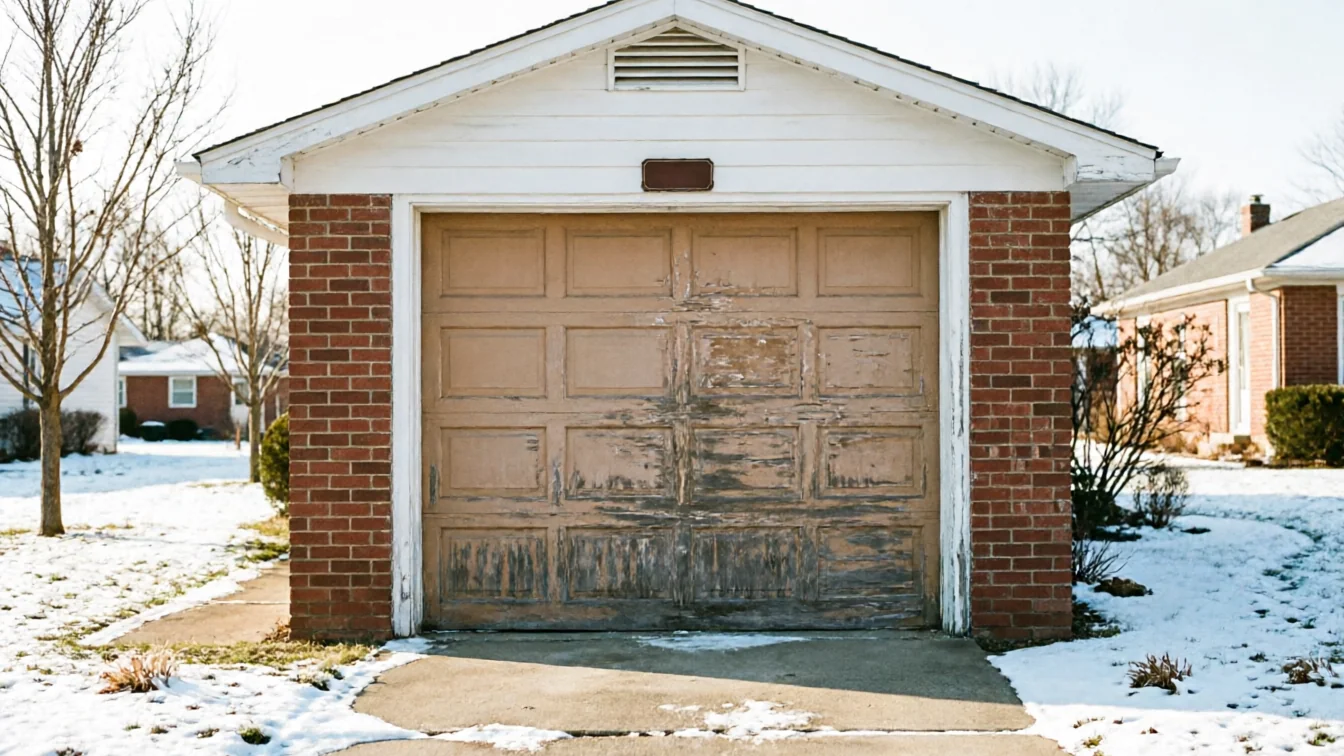
Troy's housing stock runs from 1938 to 2000, with the median build year landing at 1958. That means a large share of the garage doors in this part of Oakland County are original to houses built decades before anyone was thinking about insulated panels or galvanized torsion hardware. Across the 42 named areas that make up this stretch of southeast Michigan - including the neighborhoods closer to Birmingham and Bloomfield Hills, and the smaller lots toward Berkley - the pattern holds: most homes predate 1960, and a good number of garages still carry the one-piece or early sectional doors that came with the house.
That's not a complaint about the construction. Those doors were built solidly for their time. But the hardware wasn't designed to run sixty-plus years without a rebuild, and a torsion spring rated for a certain cycle count doesn't care how well the house around it has aged. If your door still lifts the way it did when the house was new, you've either had the spring replaced once already or you're overdue.
What Local Conditions Do
Put the housing age and the climate together and you get a specific, predictable failure pattern, not a random one. Original torsion springs on 1950s and 60s construction were sized for lighter, uninsulated doors. A lot of those doors got swapped for heavier insulated panels at some point without anyone upsizing the spring to match, so the spring is working harder than it was built for, in a climate that already stiffens steel every winter.
Track alignment is the other recurring issue. Slabs poured in the late 1950s have had seventy-plus years to settle, usually unevenly, and a track that's a half-inch off plumb doesn't show up as a problem until a cold morning when the rollers are tight and the opener has to fight harder to pull the door through. That's usually when a homeowner calls about a 'broken' door that's actually just out of adjustment.
None of this means every older door is a lost cause. A torsion spring is a wear part - it gets replaced on a schedule regardless of the door around it. The door itself, if the panels and track are square, often has a lot of life left once the spring and rollers are brought current.
What You Pay
We don't post a price list here because the honest range depends on what's actually wrong. A spring swap on an original door is a different job from replacing rollers, hinges, and a cable all at once, and a door neglected for fifteen years sometimes needs all three.
What we can tell you is how we think about it. With a median household income in this area around $89,836, most homeowners here could afford to replace a door outright if they wanted to. Plenty still choose to fix the one they have, because a well-built door from the 1950s or 60s, once the spring and hardware are current, still runs fine - nothing requires replacing a door just because it's old.
The one real limitation: if the original panel sections are warped, rusted through, or the track is bent past straightening, we'll say so up front instead of patching around it. Rebuilding a door that's structurally gone just moves the failure a few months down the road, which costs more than paying once for a new door. Parts for the oldest hardware also take longer to source than a modern roller, which is worth knowing before you commit to a repair timeline.
Frequently asked questions
My garage door is from when the house was built in the 1950s. Is it worth saving?
Usually, yes, if the panels and track are still square. Most of what fails on a door that old is the spring and the rollers, not the door itself. We check the frame and track alignment first - if those are solid, a spring and hardware rebuild gets you years more out of a door that's already proven it was built well.
Why does my spring only seem to break in winter?
It's rarely a sudden break. Cold steel loses flexibility, and a spring that's already fatigued from years of cycling finally gives up under the added stress of low temperatures. The failure feels sudden, but the wear built up over the warmer months before winter pushed it past the point of working.
Do you replace doors, or just repair the old ones?
Both. We'll tell you which one makes sense for your door rather than defaulting to either. If the spring and rollers are the only issue, we fix those. If the panels are warped or the track is bent beyond straightening, we'll say so and talk through replacement instead of rebuilding something that's already failing structurally.
Related garage door services in Troy
More garage door guides
Book garage door service in Troy
Call now or request a quote - tell us what the door is doing and where you are.